Alexandria, Virginia
Wine Cooler Repair in Alexandria, VA
Wine Cooler Repair in Alexandria, Virginia, with published price ranges up front, the fault confirmed by diagnosis before we quote the repair, and one written figure before any work begins.
Alexandria, Virginia
Wine Cooler Repair in Alexandria, Virginia, with published price ranges up front, the fault confirmed by diagnosis before we quote the repair, and one written figure before any work begins.
Wine storage is a promise kept at 55 degrees, and a cooler drifting ten degrees is breaking it slowly. We service wine coolers and beverage centers, dual zone included, and we diagnose with the collection's value in mind: temperature first, parts second. Ask around Alexandria and the wine cooler stories rhyme: the odd noise ignored for a month, the few degrees lost a week at a time, then the call. The diagnosis is what separates the cheap version of that story from the expensive one.
Dual zone coolers fail one zone at a time when a fan or damper quits, and both zones together when the shared cooling system fades. Door seals and hinge alignment matter more on a wine cooler than almost anywhere, because the duty cycle is constant and the target is narrow. A thermoelectric cooler that gradually loses its chill has a module at end of life; the technology has no compressor to blame and the fix is correspondingly clean.
Any repair that warms the cabinet starts with a plan for the bottles, agreed before the cooling stops. Vibration is the quiet enemy in wine storage; a cooler that hums through its shelves may have compressor mounts or a fan transmitting motion it should absorb. Temperature controls drift, and the display's confidence is not evidence; we calibrate against a reference thermometer before adjusting or replacing anything.
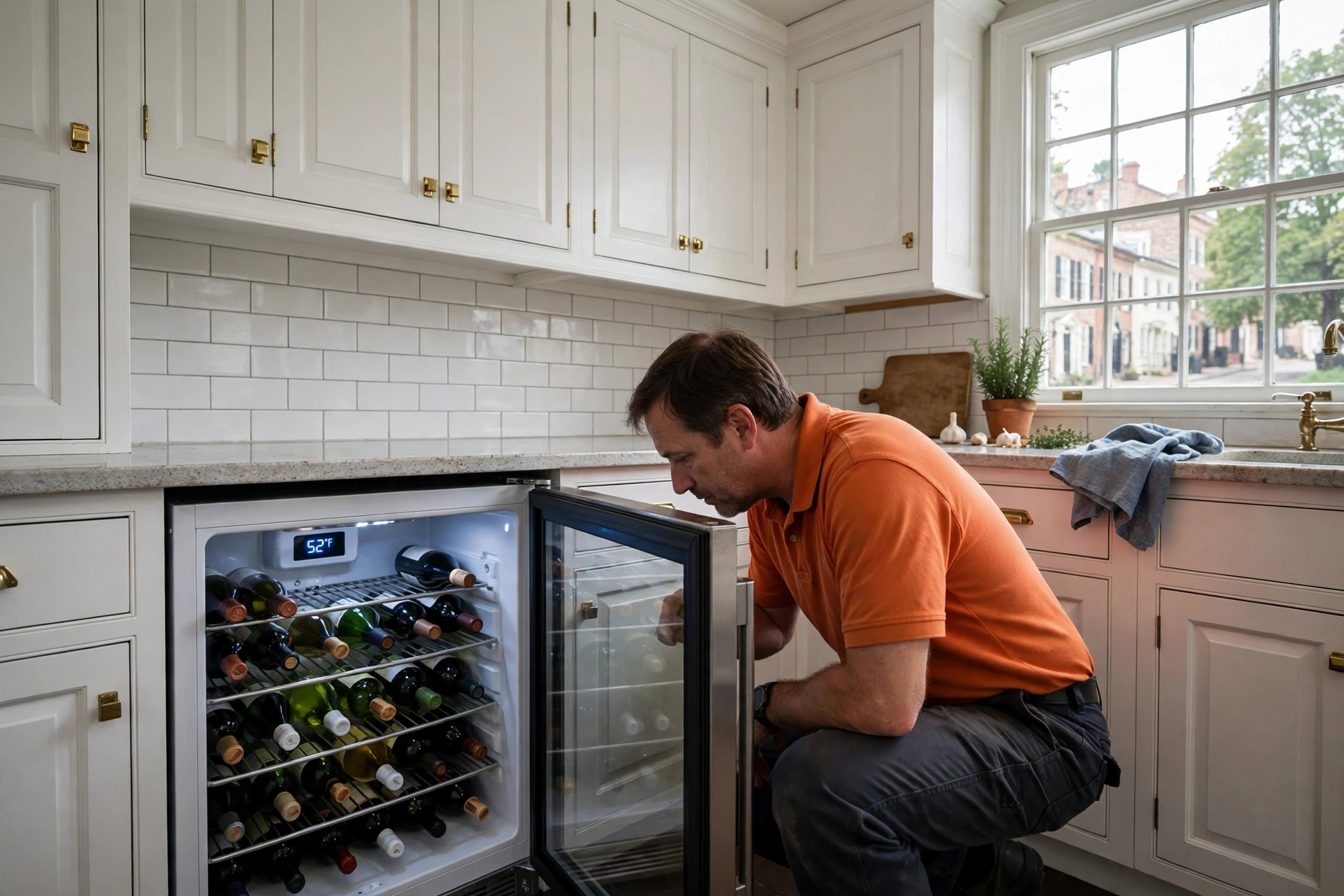
Wine cooler diagnosis is temperature mapping: reference readings in each zone, over time, against the set points, plus fan, seal, and control tests. Second units in Alexandria basements and garages get the same testing as the kitchen upstairs.
A call from Potomac Yard: Beverage center display reading ten degrees optimistic. Testing found a drifted cabinet sensor, cooling system sound. We replaced the sensor and calibrated the display against an independent thermometer. Seminary Hill to the West End, the pattern holds: test first, then talk numbers.
What moves the figure is the cooling technology: thermoelectric modules are clean swaps, while compressor systems carry the full refrigeration labor story. There are no parts ordered on a hunch: the figure follows the diagnosis, in writing, and it holds for the work described. Storm flickers off the river write themselves into control boards across this city every summer.
Our rule is facts at serving temperature: independent thermometers, zone by zone, so the repair is aimed at a measured fault. If the repair stops making sense at any point in the diagnosis, you hear it at that point, with the numbers. That rule has cost us jobs and earned us the neighborhood, and it is not changing. Old Town's historic housing rules shape how we plan Alexandria visits, and the planning starts on the form.
A zone fan or damper has failed, or that zone's sensor is lying to a shared control. Testing separates distribution faults from capacity faults, and the distribution ones are the affordable kind. Written figures are the custom here, because Alexandria households plan repairs like they plan everything else, on paper.
Aim for the mid fifties and prize stability over the exact digit. Drift and cycling do more damage than two degrees of honest offset. Alexandria sits in hard water country, and every diagnosis here quietly accounts for scale.
Usually yes: the modules are the wear part and replacing them restores the unit completely. When the control and modules both fail on an old cabinet, we show the comparison. Potomac Yard's newer builds run different fault patterns than Arlandria's older kitchens, and both are familiar ground.
Published guides put a diagnostic visit at $75 to $125, usually credited toward the repair. On a wine cooler it includes independent temperature verification in every zone. The visit closes with the machine running its real work; Alexandria owners would accept nothing less.
It is losing cold or losing capacity: gasket leaks, a struggling fan, dirty coils, or a fading system. Constant running is the symptom that pays to chase early, because compressors die of it. Del Ray and Rosemont owners tend to keep machines for decades, and our records are kept with that horizon in mind.
Beverage centers are serviced on this page as well, tested with the same zone by zone temperature method. Landmark area high rises route their laundry and kitchen work through the same diagnostic standard as the single family streets.
Tell us which appliance is failing and how, or which appliance you need installed. We read every request that comes in and respond with the published range for that kind of work and the next step, starting with a diagnostic visit to confirm the fault.
Prefer to talk it through first? Send the form and we will call you back at the number you give us.